GyroOn mobile: tilt the phone to rotate the shape. iOS will ask for permission.
SliceReal-time cross-section: a hyperplane cuts through the shape along its outermost dimension. The slider moves the cutting plane from −1 to +1. Hit Sweep to animate the plane bouncing end-to-end — a 4D tesseract rotated 45° produces the sequence point → tetrahedron → octahedron → tetrahedron → point.
Draw ShapeSketch any 2D polygon on the canvas, then extrude it into 3D, 4D, and beyond — the same way a square extrudes into a cube. Click to place vertices; click the first point (orange ring) to close. Use the dim buttons to extrude further.
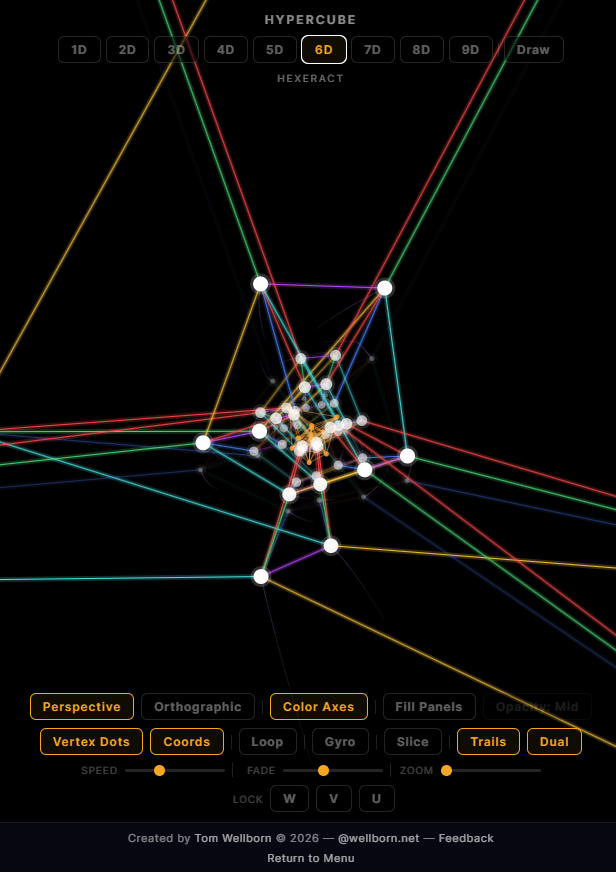
TrailsEach vertex leaves a fading path as the shape rotates. In higher dimensions the curves are projections of trajectories through SO(n) — geometry that has no analogue in 3D intuition.
DualOverlays the dual polytope (cross-polytope / hyperoctahedron) in amber. The dual of a cube is an octahedron; the dual of a 4D tesseract is the 16-cell. Both rotate together, sharing the same axes.
SoundEach dimension axis drives a separate oscillator tuned to an A-major scale (A2–E4). Gain and stereo position update every frame from the projected edge geometry — the sound is the shape, live. Higher dimensions add more voices; rotating locks quiet some, amplify others.
Focus (H)Hides all controls, labels, and UI — leaving only the rotating shape. Press H or Esc to restore. Ideal for screen recording or sharing without noise.
ShareCopies a link to your clipboard that restores the current configuration exactly — dimension, projection, all active modes, slider values, and view angle. Open the link in any browser to pick up where you left off.
About
An n-dimensional hypercube is formed by extruding an (n−1)-dimensional cube along a new perpendicular axis. Each step doubles the vertices. Shapes are mathematically exact — rendered via cascading perspective projection through each spatial dimension. Custom shapes use the Cartesian graph product to extrude any polygon into higher dimensions.
Hypercube
Square
Click to place vertices · Click the first point (orange ring) to close